Thursday, September 29, 2011

The Jerome Lejeune Foundation

Many of my readers have heard me praise the good work of the Jerome Lejeune Foundation which has a clinic in France which treats people with Down syndrome and funds ethical research projects worldwide to improve the cognition of those with Down syndrome.
If you haven't then you can read my articles about the Foundation here and about Dr Lejeune himself from his daughter here. I wrote the entry on Jerome Lejeune for the Encyclopedia of Catholic Social Thought which will be published next year. We owe so much to this valiant man who is also a candidate for sainthood.
I would like to ask my readers to LIKE the Jerome Lejeune Foundation on Facebook to show your support for the pro-life legacy of Dr Lejeune.

Bookmark and Share

Health Matters: Down Syndrome

Wednesday, September 21, 2011

The book cover is in!

To keep up with the progress of the book,  and for information on where to order it when it becomes available, see the book blog A Special Mother is Born. 
Bookmark and Share 

New survey says life with Down syndrome is good; so why the 92% abortion rate?


We who love someone with Down syndrome know this. Life is good. Challenges abound, but the rewards are greater, and far outweigh the sacrifices. When I feel those soft little arms tight around my neck, I forget how long it takes her to get dressed, eat dinner, and walk into school. My heart melts and I am thankful God chose me to raise a child like Christina.
But the common perception is that the difficulties outpace the joys, or there wouldn't be a 92% abortion rate. Thank you Dr Brian Skotko of Children's Medical Center, Boston, for compiling this data which proves that the public perception of life with Down syndrome is wrong. Now we who love these special people need to bring this survey out of hiding into the public eye, to help change hearts. To save lives. 
Leticia & Christina photo by Shana Sureck
Share this post  on Facebook and Twitter  by clicking the Share button on the bottom of the post. Discuss it at your next school meeting, coffee house visit, over the fence chat or TV spot. Write about it to the editor of your local newspaper, or call into radio shows discussing disabilities. Get the good news out, and we'll see fewer abortions of these lovely individuals who have so much to offer our society. 
BOSTON, Sept. 21, 2011 /PRNewswire via COMTEX/ -- Survey results may inform decisions about prenatal testing
Three related surveys led by a physician at Children's Hospital Boston suggest that the experience of Down syndrome is a positive one for most parents, siblings and people with Down syndrome themselves. The results, published in three reports in the October issue of the American Journal of Medical Genetics, may serve to inform expectant parents and clinicians providing prenatal care.
"New prenatal tests for Down syndrome are set to come out as early as the end of this year," says Brian Skotko, MD, MPP, a clinical fellow in genetics at Children's Hospital Boston. "Many more women will then learn about the diagnosis prenatally and will need to grapple with very personal pregnancy options. In previous surveys, mothers have reported receiving inaccurate, incomplete and occasionally offensive information about Down syndrome from their healthcare providers."
Skotko and collaborators Susan Levine, MA, CSW, of Family Resource Associates (Shrewsbury, NJ) and Richard Goldstein, MD, of the Department of Psychosocial Oncology and Palliative Care, Dana-Farber Cancer Institute, sent surveys to 4,924 households on the mailing lists of six nonprofit Down syndrome organizations around the country. The surveys asked respondents to rate their agreement with statements on a scale of 1-7, and also included some open-ended questions.
The first study evaluated surveys from 2,044 parents or guardians, representing an estimated response rate of 29 percent. Its findings:
99 percent of parent/guardians said they loved their child with Down syndrome
79 percent felt their outlook on life was more positive because of their child
5 percent felt embarrassed by their child
4 percent regretted having their child.
The second study evaluated responses to similar questions from 822 brothers and sisters age 9 and older (estimated response rate, 19 percent). Of the siblings age 12 and older:
94 percent expressed feelings of pride about their sibling
7 percent felt embarrassed by their sibling
4 percent would "trade their sibling in" for another
88 percent said they felt they were better people because of their sibling with Down syndrome
Of siblings aged 9-11:
97 percent said they loved their sibling
90 percent felt their friends are comfortable around their sibling
The third study evaluated survey responses from 284 people with Down syndrome (estimated response rate, 17 percent). The average age was 23, and 84 percent were living with one or both parents/guardians. The findings:
99 percent said they were happy with their lives
97 percent liked who they are
96 percent liked how they look
86 percent indicated they could make friends easily
4 percent expressed sadness about their life.
"As international discussion is mounting over the new prenatal tests, family members have now had their say about life with Down syndrome," says co-author Levine. "And, more importantly, the people with Down syndrome themselves have clearly stated that they consider their lives valuable."
In open-ended questions, parents reported learning a variety of life lessons - the top five being: personal self-growth, patience, acceptance/respect, love, joy. Asked what they would tell other prospective parents of a child with Down syndrome, the top responses fell into these categories:
You will experience joy/rewards
There will be struggles/challenges
You will experience love
Important to identify good support group/resources
Children with Down syndrome are more alike than different from typically developing children.
Siblings, asked what they would tell prospective parents having a child with Down syndrome, most often conveyed that the experience would be joyful and rewarding, though many also said there would be challenging moments.
Respondents with Down syndrome most often gave these kinds of messages for parents:
Love your baby/your baby loves you
Life is good/happy to be alive/positive
Don't worry/it's okay.
Their main messages for doctors were:
Life is good/I'm happy to be alive/positive
Please take care of our medical needs
Please give information to parents about school options for people with Down syndrome
Value us/we're okay.
The researchers acknowledge that the surveys are subject to selection bias, since members of nonprofit Down syndrome groups may not be representative of the general population of Down syndrome families; respondents were largely white and middle to upper class. There is currently no population-based registry for people with Down syndrome.
"Prenatal decisions about Down syndrome present profound and deeply personal challenges to expectant parents," says co-author Goldstein. "What has been missing has been the perspective of those living with Down syndrome. This study now provides the largest and most comprehensive portrait of life with Down syndrome to date."
The studies were supported by grants from the Tim White Foundation, the Fred Lovejoy House-staff Research and Education Fund, and the Joel and Barbara Alpert Endowment for the Children of the City.
Children's Hospital Boston is home to the world's largest research enterprise based at a pediatric medical center, where its discoveries have benefited both children and adults since 1869. More than 1,100 scientists, including nine members of the National Academy of Sciences, 11 members of the Institute of Medicine and nine members of the Howard Hughes Medical Institute comprise Children's research community. Founded as a 20-bed hospital for children, Children's Hospital Boston today is a 396 bed comprehensive center for pediatric and adolescent health care grounded in the values of excellence in patient care and sensitivity to the complex needs and diversity of children and families. Children's also is the primary pediatric teaching affiliate of Harvard Medical School. For more information about research and clinical innovation at Children's, visit: http://vectorblog.org .
CONTACT: Keri Stedman Children's Hospital Boston             617-919-3110      keri.stedman@childrens.harvard.edu
SOURCE Children's Hospital Boston
Copyright (C) 2011 PR Newswire. All rights reserved 

Bookmark and Share

Friday, September 9, 2011

Clinical trials for Down syndrome drug at Roche Labs


from PR Newswire

Roche today announced the initiation of its first Phase 1 clinical trial to investigate the safety and tolerability of a molecule designed to address the cognitive and behavioral deficits associated with Down syndrome.

"There is currently a large unmet medical need for the treatment of cognitive impairments in individuals suffering from Down syndrome," comments Luca Santarelli, Global Head of Roche Neurosciences Disease Translational Area. "Our strategy at Roche neurosciences is to specifically address these serious conditions that have no approved, effective or safe treatment. This is why we have a strong commitment to neurodevelopmental disorders, including genetic disorders like Down syndrome or Fragile X, as well as autism spectrum disorders."

Enhancing brain functions such as cognition and language in individuals with Down syndrome holds the promise to help these individuals conduct a more independent life. This may result from the improved ability to carry out every day's practical tasks such as finding an apartment, maintaining a job, or having a more fulfilling social life. These improvements can have a significant impact on functioning and quality of life of Down syndrome individuals as well as help reduce the burden for families, caregivers and the society.

"This study will target only adults between 18 and 30 years old, but we believe that an earlier intervention in Down syndrome has the potential for a greater medical impact," says Paulo Fontoura, Head of Translational Medicine in the Roche Neurosciences Disease Translational Area. "While we are still at the early stage, we are confident that our drug's mechanism of action can potentially open the door to further promising investigations in upcoming years."

Based on animal models, an imbalance between excitatory and inhibitory neurotransmission has been proposed among the underlying causes of altered brain function in individuals with Down syndrome. Roche's investigational drug is being assessed for its ability to address this imbalance by targeting the GABAergic* system.

*GABA: gamma-amino butyric acid

This placebo-controlled study will assess the safety and tolerability of the investigational drug in individuals with Down syndrome. It will recruit up to 33 individuals in one or two countries. For more information on the study, access the Roche Clinical Trials Protocol Registry and Results Database: http://www.roche-trials.com/

This is wonderful news. Once the pharmeceutical community catches on to the fact that there is more money (or at least as much) in improving the lives of those with Down syndrome than there is in ending them through prenatal testing and abortion, then we might have a true chance to give people with Down syndrome the same chance at a normal life that has been given to many others who have medical conditions.

Its about time!

This GABA drug sounds like what Dr William Mobley was describing in his lecture at Cold Spring Harbor Labs in spring of 2009. He estimated it would take ten years to bring the drug to the market, and now clinical trials are beginning after two years. That's eight years to go.

Read the entire article here.

Bookmark and Share

Tuesday, September 6, 2011

STOP: Count your blessings

Hurricane Irene had wreaked havoc upon the Quiet Corner of Connecticut where we live.
Gabbi and I were on a reconnaissance mission to our tiny hamlet when the unusual STOP sign message made us pause. Someone had stenciled "Count your blessings" in white under the word STOP. We smiled and sent up a quick "deo gratias", while continuing our important objective; to find potable water to bolster our diminishing supply. It had been two days since Hurricane Irene, and the power outage was fast morphing into the greatest challenge of our life as a family. Yet no one was hurt, our home was not damaged or in danger, and we were finding strengths within ourselves as the challenges mounted. And despite feeling grubby, we were having the adventure of our lives.
The initial hours of the hurricane were the easiest by far of the week which followed.Trees swayed in the rainy wind, and a few branches flew down. Naturally the power was out. but nothing disastrous had happened, and the girls and I felt oddly disappointed as we surveyed minor damage on our first walk around the neighborhood.
The big hurricane for which we had made extra trips to the store, secured the patio table, and filled containers of water, was a bust. Or so we thought.
The next day, we were dismayed to discover that most roads to our home were blocked by downed trees and alarming configurations of dead electric cable strewn across homes and roadways. All the local towns were without power, even the mighty Walmart was closed. The severity of the storm began to reveal itself to us, but the girls chipped in merrily fetching water from the stream across the street. singing the water fetching song from "The Jungle Book".
We rediscovered how to use the gas range and refrigerator in the camper, set up a field kitchen and dish washing station. There were three types of water we decided; Level One, bottled water for drinking only. Level Two for washing people and dishes, which after use, became Level Three;toilet flushing water. We learned to think about our every move, no one wasted water, food or effort, as the tasks were were engaged in cause sore shoulder muscles at night. We recovered the lost joys of board games, learned gin rummy, and discovered candlelit sponge bathing, Bella's compositions on the piano began to fill the evening stillness. I considered dusting off my violin.
After two days of relative isolation, our neighbors began to reach out. We swapped news on when the tree removal trucks would arrive and restore power, advice on where to find gas, news that the showers at the middle school were being offered to residents, and clean water was offered. We offered our fresh tomatoes, which were in full swing, in return, and took advantage of free water, showers, and any news we could get.

There is a great lack of humility in our do-it-yourself culture.  When the hurricane and the week-long delay in the return of electric power forced us to seek help, we were humbled to find it so readily available. We had tears of gratitude spring to our eyes at the sight of the soldiers of the National Guard dropping off bottled water and military meals at the Town Hall, and our admiration for our soldiers grew as we ate some of their hearty meals, imagining soldiers in Iraq or Afghanistan eating the same beef stew and oatmeal cookies we ate, making their orange drink in their canteens. We were a little reluctant to use the showers in the school, yet met friendly smiles and helpful neighbors who were becoming friends. We got to know six new households over that week, and celebrated the restoration of power with a block party. After moving to CT three years ago from Long Island, outrunning Hurricane Hannah as it followed us up the coast, we finally could say we felt like integral parts of the community.
I knew from experience that days without TV would work wonders on the girls, and when we found time for the nightly rosary the TV had squeezed out, and began to giggle over the day's mishaps, we knew a joy that electronic gadgets had robbed us of. We attended daily Mass, made designs with mosaic blocks, and spent time planning our homeschooling year. We fixed the chicken coop in time for our new chicks to become egg laying hens, and canned tomato sauce for winter. We were becoming even more of a team!
So, when my husband, who was tending to internet customers out of power, arrived home on Friday, he was impressed that we were so independent. We secretly prayed that God would not let our power be restored just yet, we wanted to share our adventure with Dad for at least 24 hours more. He showed us that we had an extra well which we could have accessed by lowering buckets the old fashioned way,  and we enjoyed my Minestrone soup dinner al fresco, proud of our accomplishments.
The next day found us seeking the internet at the library and buying groceries optimistically hoping that the food wouldn't spoil. Later that evening, the power was restored. We cheered the workers from New Hampshire as they passed our home, and resumed normal life, not without wistfulness about the strange beauty of the week where we were off the grid but far from powerless.

Bookmark and Share

Sunday, September 4, 2011

Take me to the fair


We enjoyed two weeks with our Long Island family and friends at the beginning of August. This included  trips to the petting farm near Grandpa's,  trips with cousins to the beach and reunions with dear friends like Mary Faith and Tammy, a contributor to "A Special Mother is Born".
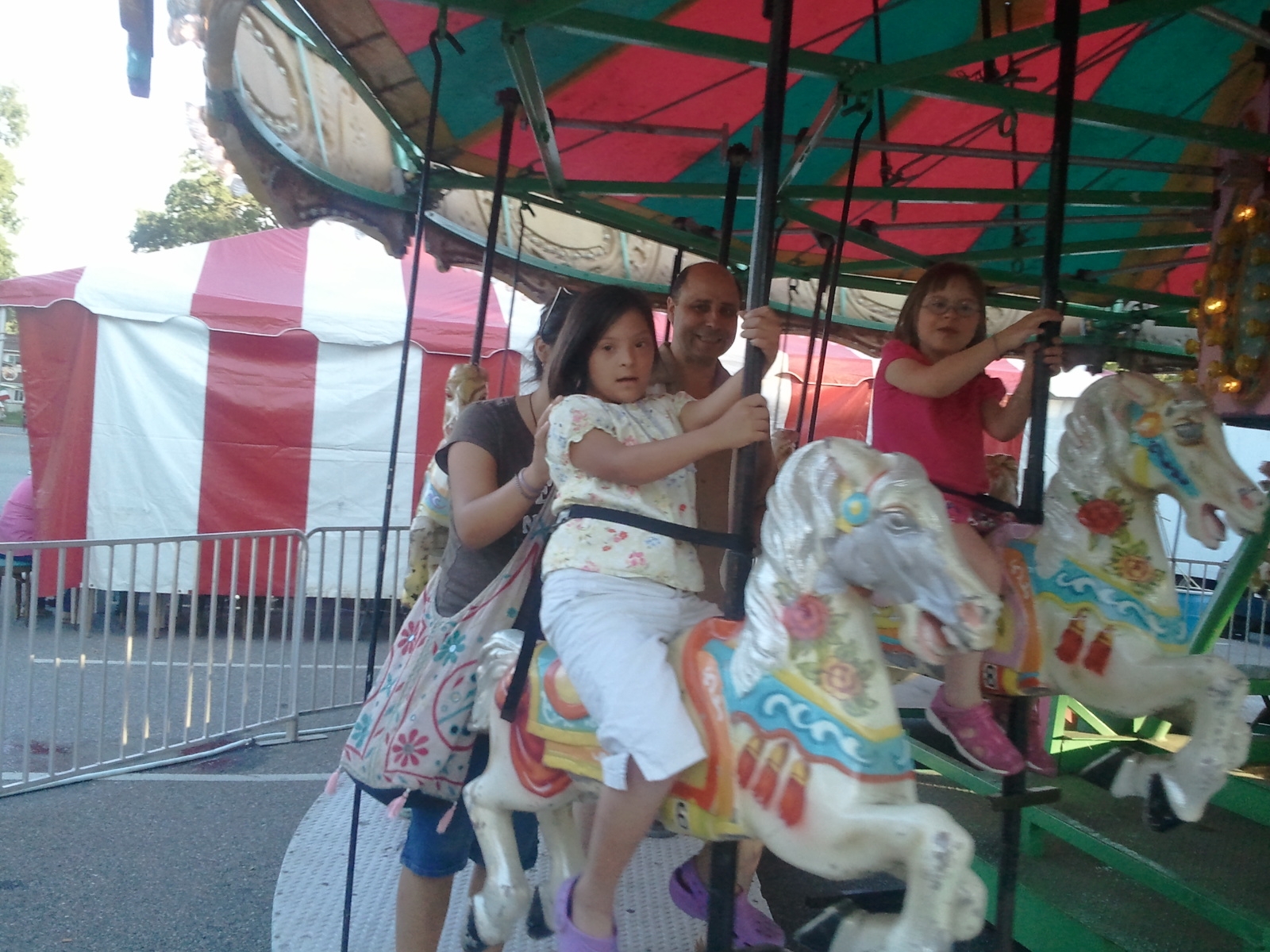
Here are Christina and Mary Faith enjoying the rides at a Fair for the Feast of the Assumption.
Every time these two get together, the time apart melts away and they are in sync again. They 'get' one another's signals in a way we moms can only admire.

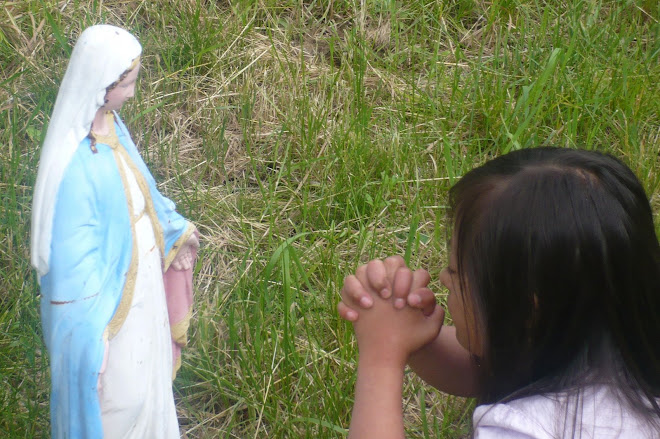
Look at their concentration while driving. . .and praying.

Bookmark and Share